
Stress and Insomnia – Why the Mind Stays Awake When the Body Is Tired

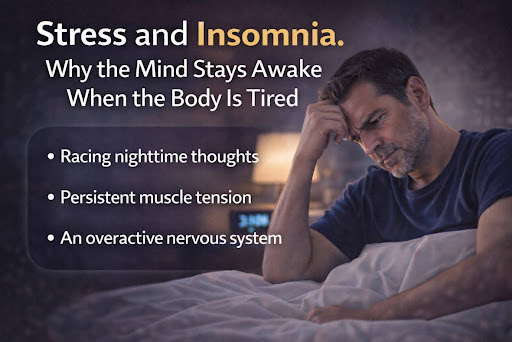
This has happened to almost everybody.
- You feel exhausted.
- Your body is heavy.
- You want sleep.
Still, as soon as your head rests on the pillow, your mind cannot put a foot to it.
Thoughts replay the day. Fear of tomorrow is expressed. Minor concerns seem to have bigger voices.
This does not mean lack of discipline. It is not a breakdown of not being able to switch off. The way stress and insomnia interact within the nervous system is how it is. This is a relationship that is usually learned to begin genuine improvement.
Stress Is Not Always Obvious
When individuals consider stress they will think of work pressure, deadline or emotional situations. However, stress is more than that.
Stress can be:
- Inadequate rest due to the long working hours.
- Irregular sleep schedules
- Continuous alerts and display on the screen.
- Pain or health concerns that are unresolved.
- Silent nervousness that does not completely shut down.
Nevertheless, the nervous system might also be in survival mode even when life appears to have been stable.
Insomnia often begins there.
Why Stress Shows Up at Night
The brain is kept busy throughout the day. Activities, discussions, movement and noise are competing areas of attention. There are stress signals, which do not necessarily come to attention.
At night, everything changes. External stimulation drops. The nervous system becomes inward. Thoughts that were repressed in the day come about. In case the stress has been piling up, then the first silent moment when the brain makes an attempt to work with it is at bedtime. This is the reason why they say that I feel fine during the daytime and night is the worst.
The Nervous System and Sleep Readiness
The body does not decide the issue of sleep intellectually. It is a physiological state.
The nervous system is required to be safe enough to relax in order to sleep.
Stress maintains vigilance of the system. The alert systems are insomniacs.With continuous presence of stress hormones, the body will always be on the lookout even when it is not needed.
This is an incompatible fit, giving rise to insomnia.
The Effect of Insomnia in Strengthening Stress.
When it becomes hard to sleep, another layer of stress is presented. Human beings begin to be concerned with sleep as such.
- They watch the clock.
- They calculate hours left.
- They look forward to being fatigued the following day.
This expectation will trigger the nervous system even more, making it even more difficult to fall asleep.
The sleeplessness that started off as a result of stress becomes a vicious cycle.
Why Trying Harder is Making Sleep Worse.
A large proportion of the population would react to insomnia by attempting to regulate sleep.
- They force earlier bedtimes.
- They lie still for hours.
- They focus on breathing with effort.
Unfortunately, effort signals alertness. The nervous system interprets effort as a need to stay awake.
Sleep improves when the system relaxes, not when it is forced.
Stress, Cortisol and Night time Wakefulness.
Cortisol is involved with the regulation of energy and alertness. In the usual state of things, there is a decrease of cortisol at night.
This rhythm is interfered with by chronic stress.
Cortisol can be elevated when it is expected to decrease. The body remains in a partially activated state. Sleep is either light, fragmented, or delayed.
This hormonal pattern explains why stress-related insomnia often includes early morning awakenings or restless sleep.
Physical Symptoms of Insomnia caused by Stress.
Stress is not a permanent requirement in the mind.
Individuals experiencing insomnia as a result of stress tend to observe:
- Squeezed shoulders or jaw, at night.
- Restless legs
- Shallow breathing
- Racing heart sensations
- Increased pain sensitivity
This is an indicator of activating the nervous system rather than individual weakness.
Why Insomnia Feels Worse During Certain Life
Transitions are usually periods of stress and insomnia. Year ends. New years. Job changes. Health concerns. Emotional shifts.
Even positive changes create uncertainty. The nervous system responds to uncertainty by staying alert.
This is why insomnia often appears during times of reflection or pressure to “start fresh.”
When Stress-Related Insomnia Becomes a Health Issue
The poor sleep is occasionally normal.
Insomnia: Medical review is significant when:
- Persists for weeks or months
- Affects daytime function
- Worsens anxiety or mood
- Increases pain or fatigue
- Results in dependencies on coping.
Insomnia as a sleep disorder is not chronic. It has an impact on physical and mental health.
Why Addressing Stress Improves Sleep More Than Sleep Tricks.
Numerous sleeping hints revolve around outward appearance. Dark rooms. Cool temperatures. No screens. These are relevant, though they do not solve underlying stress. Sleep is usually enhanced when one tackles stress without coercing. The nervous system will automatically change to rest.
Physicians are concerned with relaxing the system, but not with maximizing the environment.
What Actually Helps Calm the System
Change is typically not achieved through intensity but rather through consistency.
- Predictable routines
- Gentle evening transitions
Decreased stimulation at the end of the day.
- Regular wake times
- Daytime movement
Taking stress out earlier than the day.
These are the signals which inform the nervous system that it is safe to take a rest.
Why Stress and Insomnia Should Be Addressed Together
The use of insomnia treatment without dealing with stress is not very successful. The focus on treating stress without regard to sleep tends to put a halt on progress. They reinforce each other. The combination of both is more stable to improve. Such a combined treatment method is gaining more and more importance in healthcare.
What to discuss with Doctor?
Effective communication is important in this and hence discuss:
- Duration of sleep problems.
- Night time thinking or physical anxiety.
- Daytime stress patterns
- Impact on mood, pain, or focus
What has already been tried
This can be used to steer the right course of action.
A Realistic Expectation for Improvement.
Sleep does not typically reoccur during the night.
Improvement will likely appear as:
- Sleeping a little bit more quickly.
- Fewer awakenings
- Less anxiety about bedtime
- More consistent energy
These minor movements are an indication that the nervous system is re-calibrating.
A Practical Takeaway
There is a close relationship between insomnia and stress. One keeps the other alive. When your mind is not resting because of being tired and your body, then you are not doing anything wrong. It is that your system has been taught to be too long on guard. This can only be improved by relaxing the system rather than combating it.
Our 2026 Health Reset Guide will help you in nurturing your health to next level.
It is not hard work that you get rest.
When your nervous system is eventually safe, it is something that it permits.