
Insomnia and Mental Health – The Effects of Lack of Sleep on the Mind

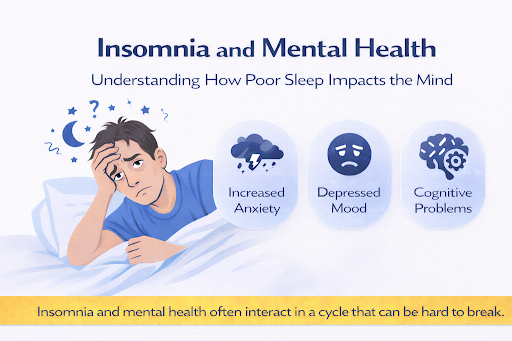
Sleep is something that is considered as optional until it begins to deteriorate. Most individuals accept the sleep deprivation as a stress, work pressure, or old age. However, once the insomnia is chronic, it is not confined to sleep. In the long run, it starts to influence mental health in subtle although effective ways.
Mental health and insomnia are closely related. One affects the other and probably in a vicious circle that is hard to break without knowing what is actually occurring within the brain and the nervous system.
This article describes the impact of insomnia on mental health, why the correlation is two-way, and when sleep issues should be addressed by the physician.
Understanding Insomnia Beyond “Bad Sleep”
Insomnia is not merely the fact that one is awake late or that he or she has a sleepless night here and there. Insomnia is an issue that doctors take into account in the case of persistent, unpredictable, and disruptive sleep problems.
Insomnia may involve:
- Difficulty falling asleep
- Regular night time awakenings.
- Too early to go to sleep and not to wake up.
- Even spending hours in bed and feeling unrefreshed.
As patterns persist, the brain ceases to regard sleep as an effective period of recovery. The consequences of that change affect mental health.
The Importance of Sleep to the Mental Wellbeing
Sleep is not passive rest. It is a dynamic process whereby the brain:
- Regulates emotions
- Processes stress
- Consolidates memory
- Reestablishes neurotransmitter balance.
- Slows down the activity of the nervous system.
The lack of sleep leaves the brain in the state of high alert. With time, this excessive stimulation has an impact on mood, thinking and emotional control.
How Insomnia Affects Emotional Regulation
Emotional instability is one of the initial mental health transformations associated with insomnia.
The lack of sleep impairs the capacity of the brain to control emotional reactions. The cases which usually seem manageable start to be overwhelming. Less impressive stressors elicit more intense responses.
Insomnia is characterized by complaints of people:
- Irritability
- Low frustration tolerance
- Mood swings
- Feeling emotionally “raw”
This is not a character weakness. It is the neurological reaction to the lack of recovery.
The Relation between Insomnia and Anxiety
Insomnia and anxiety are two facets that go hand in hand and support each other.
A nervous mind finds it hard to calm down in the evening. Racial thoughts, anticipation, and physical tension disrupt sleep initiation. Subsequently, insomnia makes the following day more anxious.
This creates a cycle:
- Anxiety disrupts sleep
- Sleep deprivation increases anxiety.
- Night is equated with stress and not rest.
In the long run, even the bed per se becomes a cause of concern.
Insomnia and Depression: A Two-Way Relationship
Sleep disturbance is one of the most frequent depression symptoms. It also poses a risk towards development of depression.
Insomnia may cause depression by:
- Drying motivation and energy.
- Impairing concentration
- Desensitizing to emotional appeals.
- Growing sense of desperation.
Meanwhile, depression changes the sleep architecture, which complicates the process of restorative sleep.
Insomnia is a concern of doctors during an assessment of the mental health since treatment of sleep usually leads to better mood results.
Cognitive impacts of Chronic insomnia
Mental health does not entirely lie on the mood.
Long term sleep deprivation negatively impacts cognitive ability including:
- Attention
- Memory
- Decision-making
- Processing speed
Insomniacs tend to complain of mental fog concept, inability to concentrate or lack of connection with their thoughts. Such symptoms are similar to anxiety or depression making it hard to diagnose them.
Restoration of sleep usually enhances mental clarity.
Why Insomnia Makes Stress Feel Unmanageable
Stress is unavoidable. Sleep assists the brain to re-set stress reactions.
Without proper sleep:
- The level of cortisol is still high.
- The nervous system remains in fight or flight situation.
- Stress tolerance decreases
Consequently, the slightest difficulties are draining. There is a loss in emotional strength.
This is the reason why the people who have insomnia will always complain that they are always on their toes.
The Nervous System’s Role in Insomnia and Mental Health
Insomnia leaves the nervous system awake at the time of slowing down.
The brain is unable to switch between daytime wakefulness and night sleep. This chronic activation enhances the susceptibility to anxiety, mood swings and burnout.
One of the treatments of insomnia is the tendency of doctors to calm the nervous system.
When Sleep Problems Become a Mental Health Warning Sign
Poor sleep is an occasional occurrence. Persistent insomnia is not.
Physicians believe additional examination is necessary when:
- Problems with sleeping take weeks or months.
- Functional or daytime mood deteriorates.
- Symptoms of anxiety or depression aggravate.
- Sleep anxiousness or nocturnal phobia evolves.
- There is loss of concentration and motivation.
One of the first signs of underlying mental health stress is a sleeping problem.
Treatment Approaches Address Both Sleep and Mental Health
Insomnia is hardly a condition treated in isolation by doctors.
There are usually four key components to effective treatment:
- Treating images or mood problems.
- Improving sleep hygiene
- Regulating sleep schedules
- Managing stress responses
- When suitable short-term medication.
This is aimed at restoring the natural capacity of the brain to rest.
The Role of Medication in Severe Insomnia
There are instances where physicians prescribe sleeping medicine to wake the body of the sleep cycle.
Medication can be considered to be used when:
- Mental health is largely affected by insomnia.
- The non-medication strategies are inadequate.
- Stabilization of sleep in the short term is required.
These are not independent strategies, although medication is typically combined with behavioral and lifestyle approaches.
Long-Term Risks of Ignoring Insomnia
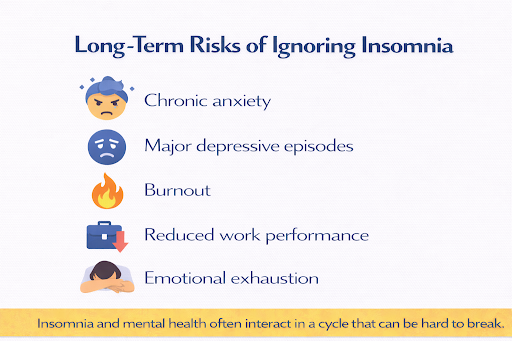
Untreated insomnia exposes the risk of:
- Chronic anxiety
- Major depressive episodes
- Burnout
- Reduced work performance
- Emotional exhaustion
Early sleep methods guard against mental and physical wellbeing.
What to Discuss With Your Doctor
In case insomnia is contributing to your mental condition, discuss:
- Sleep patterns and duration
- Stress and anxiety levels
- Mood changes
- Medications or supplements
- Stresses at work and lifestyle issues.
Honest conversations assist physicians to find the appropriate way.
Improving Sleep Supports Mental Health Recovery
Many mental health problems cannot be solved by better sleep. However, it makes the brain stronger to endure, digest and recuperate.
When sleep normalizes, many individuals report feeling better, clear and emotionally balanced.
Sleep is not a luxury. It is a foundation.
In case of sleep medication prescriptions, other patients prefer an online pharmacy to be convenient and discreet.
- Authentic medication
- Secure checkout
- Discreet delivery
- Regulatory compliance
Patients are not supposed to rely on unverified sources.
A Practical Takeaway
Insomnia and mental health cannot be separated. Sleep deprivation undermines emotional control, elevates anxiety and aggravates mood disorders. Meanwhile, sleep disturbances are caused by mental health problems.To solve this cycle, one needs to know, medical advice, and time. The restoration of mental balance is also commonly achieved by treating sleep.