
Why Anxiety Can Be a Physical not a Mental Process and When it Requires Medical Help

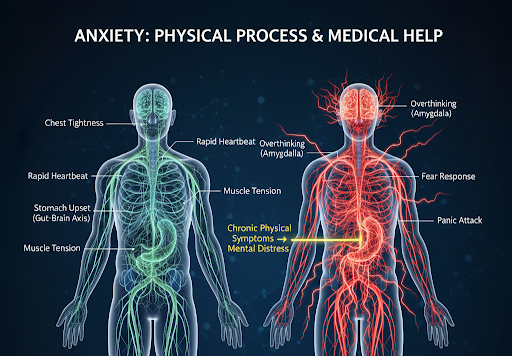
Anxiety is not something understood. Anxiety is considered by people with worry, overthinking, or fear. The fact is that, it normally presents itself in the body first, and, often, a long time before an individual can notice that he or she is anxious.
- Tight shoulders.
- Chest pressure.
- Shortness of breath.
- Digestive discomfort.
- A racing heartbeat.
This is a set of symptoms that can be frightening, particularly when they do not have an apparent cause of emotion. To most adults, particularly past the age of 35, anxiety is more a bodily than a psychological experience.
The reason why anxiety is physical among adults
When a person is faced with anxiety, his body triggers its stress response system, which is supposed to safeguard him in times of threat. This problem arises when this system remains on longer than it should.
When anxiety is ongoing:
- Muscles remain tense.
- Breathing becomes shallow.
- Heart rate stays elevated.
- Digestion slows.
- Sleep becomes lighter.
The body is in a permanent position of alertness and therefore some minor stressors may have serious physical reactions with time.
It is the reason why nervous people refer to the doctor, believing that they have some heart, lung, or stomach problem, when the root cause is heart overstimulation through the nervous system.
Symptoms of anxiety that are not well understood
Anxiety in adults is likely to cause common physical symptoms such as:
- Chest tightness or pressure.
- Shortness of breath.
- Muscle pain or stiffness.
- Abdominal pains or nausea.
- Headaches.
- Fatigue.
- Dizziness.
- Restlessness.
These symptoms are real. They are not conceived or overdone. Due to the involvement of various body systems in the process of anxiety, the manifestation of the condition may change daily and it becomes difficult to notice.
Anxiety & Age Factor
The anxiety becomes more evident in later adulthood in the eyes of many adults. The reasons include:
- Sleep is less deep and more discontinuous.
- Stress recovery is a slow process.
- There is an upsurge of physical health worries.
- Daily routines change.
- Roles and life stresses mount up.
Moreover, stress that had been long-term and not considered or handled at the unconscious level may end up overwhelming the nervous system at some point.
That is why anxious symptoms among older adults usually become more overwhelming and difficult to get rid of.
Anxiety and sleep: close relationship
Sleep disruption is one of the most apparent indicators that anxiety requires the following.
Anxiety often:
- Delays falling asleep.
- Experiences frequent nocturnal awakening.
- Brings about premature awakening.
- Deterring profound, restful sleep.
Inequality of sleep at that time augments the anxiety sensitivity the next day and it forms a loop which may continue to be repeated in months or even years unless treated.
As soon as anxiety continues to influence sleep, they are not merely stressed anymore.
- Anxiety as a medical problem.
- Anxiety requires medical check-up when it:
- Disrupts normal daily life.
- Instances lead to recurrent physical pain.
- Disrupts sleep regularly.
- Leads to panic‑like symptoms.
- Influences employment, relationships or decision-making.
Anxiety is assessed by the doctors. The first one is the exclusion of physical causes and the second is the evaluation of the impact of anxiety on the nervous system.
The therapy is customized and usually a mixture of methods.
The treatment of anxiety among doctors
Anxiety is not treated by doctors in the same way to everybody.
They consider:
- Pattern and duration of symptoms.
- Sleep quality.
- Physical health conditions.
- Current medications.
- Stress load and everyday life.
Treatment plans may include:
- Stress-management and lifestyle practices.
- Sleep regulation.
- Temporary or situational physician support (where necessary).
- Constant control and corrective actions.
Drugs are employed to promote balance of the nervous-system, but they do not restrain feelings.
The reason that anxiety must not be disregarded
Life with untreated anxiety may gradually influence most life spheres:
- Energy levels decline.
- Focus becomes harder.
- Pain sensitivity increases.
- Mood stability decreases.
- Confidence drops.
Anxiety does not normally solve itself once it is chronic. Initial help is usually followed by an easier treatment process and positive long-term results.
Physical health and anxiety are closely correlated.
Anxiety in the long run exerts stress on the body. It can worsen:
- Blood pressure.
- Digestive issues.
- Muscle tension.
- Chronic pain.
- Immune response.
That is why the management of anxiety is not only about the level of mental comfort, but the maintenance of health on the whole.
How to safely manage anxiety in adults
Combining mind and body is the best approach towards anxiety care.
Doctors often recommend:
- Consistent sleep routines.
- Gentle physical activity.
- Stress‑reduction techniques.
In cases where symptoms continue, medical assistance is provided.
Medication is generally an element of a larger strategy and is re-examined on a regular basis when prescribed.
- Anxiety when to consult a doctor.
- You need to think about doctor advice in the event that:
- Symptoms of anxiety are common or exacerbating.
- Physical symptoms are oppressive.
- There is incessant disturbance of sleep.
- The state of anxiety disrupts everyday duties.
- You cannot even rest without feeling like you cannot relax.
A helping hand is a move towards stability rather than an expression of weakness.
Buy Anti Anxiety Medicines Online
In case you decided to order online and your doctor prescribed anxiety medication, safety is the key. In case anxiety medication has been prescribed as a part of your care plan, you may order the drug in a licensed online pharmacy with the safe processing and a discreet delivery.
Final thoughts
Anxiety does not exist in the head.
It is present in the nervous system and spreads to the entire body.
Anxiety can be safely addressed with proper guidance and support at the right time to enable one to resume their normal state of calmness, sleep, and comfort throughout the day.