
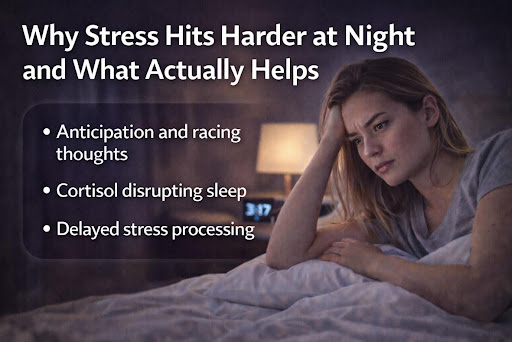
Why Stress Hits Harder at Night and What Actually Helps

Numerous individuals utter the same.
“I manage fine during the day. Nevertheless, everything unravels at night”. The house is quiet. The phone is down. The day is over. And all at once, there is stress that has been distant all day in the limelight. Thoughts speed up. The body tightens. Sleep feels far away.
This isn’t coincidence. And it isn’t weakness. It is true that stress can strike much more at night due to the nature of brain and nervous system functions. Knowing at least one of those reasons will make your approach to sleep, anxiety, and recovery different.
Daily Stresses are usually repressed, not addressed.
The majority of people are in doing mode during the day. Work. Messages. Decisions. Movement. Noise. All these leave the brain outward-looking. The signs of stress exist, but they are competing along with a variety of other inputs. The mind does not have room to process them to the full extent. So stress gets postponed. Not resolved. Just delayed. It is during the night when the brain can finally find the space to process the ignored.
Why Quiet Times Makes Stress Louder
Stress thrives in silence. In case of the stimulation drop, the nervous system scans inward. The background noise becomes foreground at night.
This is why:
- Small worries feel bigger
- Old conversations replay
- Future problems feel urgent
- Regret and pressure surface
Sabotaging of sleep is not what the brain is attempting. It is attempting to form meaning out of unprocessed input.
The Shifts in the Nervous System After Dark
Sleep involves changing alertness to safety.
Such change does not occur spontaneously.
When the nervous system has been in a high state of alert all the day, it cannot believe that all is suddenly still. It does not shut off, but remains half awake, waiting to attack what is no longer a threat.
This is why people feel:
- Tired but wired
- Sleepy yet restless
- Composed yet nervous simultaneously.
The body has not been trained that it can sleep.
Hormones Play a Role, Too
The hormone cortisol, which is coupled with alertness and stress, has a daily cycle.
During healthy patterns, cortisol decreases at night in order to permit sleep. The rhythm is disturbed through chronic stress. Cortisol can remain high instead of decreasing or increasing unpredictably. The body is on the alert to take action when it is supposed to rest.
It is this hormonal imbalance that causes stress insomnia to include:
- Difficulty falling asleep
- Frequent awakenings
- Early morning wake-ups
Why Stress Feels Physical at Night
Stress is not just mental.
At night, people often notice:
- Tight shoulders or jaw
- Chest heaviness
- Restless legs
- Shallow breathing
- Increased pain sensitivity
These are indications of nervous system mobilization.
This tension is dispersed in the day. During the night, it can be sensed because of the silence.
Anticipation Makes Nights Harder
When stress has a few incidences with sleep, a new issue emerges.
Anticipation.
People start worrying about sleep itself.
“What if I don’t sleep again tonight?”
“How will I function tomorrow?”
This anticipation raises alertness before sleep even begins. The bed becomes associated with struggle. Night does not come with stress anymore. It’s expected.
Why Distraction Doesn’t Work Long-Term
Often, individuals manage to survive by keeping themselves busy till they are too tired. Scrolling. Streaming. Late-night work. This postpones the bedtime but does not relax the system. It tends to heighten stimulation and thus the eventual sleep transition is more difficult.
Stress is delayed with distraction. It doesn’t resolve it.
What Actually Helps Stress at Night
The solution is not forcing relaxation. It’s teaching the nervous system consistency and safety.
1. Stress Needs an Earlier Outlet
Night is not the time to process the entire day.
Stress that has no outlet earlier will demand attention later.
Journaling, quiet walks, or reflection earlier in the evening give the brain space to process before bedtime.
2. Predictable Evenings Matter More Than Perfect Ones
The nervous system loves predictability.
- Going to bed at roughly the same time.
- Repeating simple evening routines.
- Lowering stimulation gradually.
These patterns signal safety. Over time, stress loses its urgency at night.
3. Breathing Works When It’s Gentle
Aggressive breathing techniques can backfire.
Slow, unforced breathing with longer exhales sends a clear message to the nervous system. No emergency. No action needed.
This works best when practiced consistently, not as a last resort.
4. Movement During the Day Reduces Night Stress
Stress is energy. Movement discharges it.
Gentle, regular movement during the day reduces the amount of tension that accumulates by night. This is especially important for people with pain or desk-heavy routines.
5. Sleep Timing Is More Important Than Sleep Duration
Trying to “catch up” on sleep rarely works.
Consistent wake-up times anchor the nervous system. Even when sleep is poor, maintaining rhythm helps the system recalibrate.
6. Reducing Late Stimulation Is Non-Negotiable
Screens, intense conversations, and problem-solving late at night keep stress active.
This isn’t about restriction. It’s about protecting recovery.
When Stress and Sleep Need Professional Input
Occasional bad nights are normal.
Medical guidance becomes important when:
- Stress-driven insomnia lasts weeks or months
- Sleep disruption affects mood, pain, or focus
- Anxiety escalates at night consistently
- Coping behaviors stop working
At that point, structure helps more than self-experimentation.
Why Medication Is Not Always the First Step
Medication can help some people, but stress-driven sleep problems often respond better when the nervous system is addressed first.
Doctors look at sleep, anxiety, pain, routines, and stress together. This integrated view leads to safer, more effective decisions.
A Realistic Expectation for Change
Stress does not disappear overnight.
Improvement often shows up as:
- Slightly faster sleep onset
- Fewer awakenings
- Less dread around bedtime
- Milder night time thoughts
These are signs the system is learning to settle again.
A Practical Takeaway
Stress hits harder at night because that’s when the mind finally has space to speak.
Silencing it doesn’t work. Understanding it does.
When stress is given structure, safety, and consistency, it loses its grip on the night.
Our Stress Relief Guide help people understand these patterns and prepare for informed conversations with healthcare providers.
You don’t need to fight stress at night.
You need to teach your system that night is no longer a time for vigilance.
That’s when real rest becomes possible.