
What Soothes the Nervous System is Nature

The majority of the people do not consider their nervous system until it begins to malfunction.
Sleep gets lighter.
Thoughts speed up at night.
Minor issues become intimidating.
Even at the time when nothing occurs, the body is tense.
Then people pose the question which is very simple: How do I quiet this down?
The nervous system is not delicate, it is sensitive. It is responsive whenever we are stressed, whenever we are on routine, when we are sleeping, when we are moving or even in the way we breathe. The body becomes accustomed to this state of being active and forgets that it can go back to a resting point.
Relaxing naturally does not mean that it is forced to do so. It is concerning the establishment of the environment in which the body will be safe enough to be able to slow down.
What Calm Means: What it really means
To be calm does not imply to feel and be sleepy during the day.
- This does not imply a lack of emotions.
- It is not about eliminating the stress out of life.
In physiological perspective, calm is associated with balance. The nervous system is flexible to be between alert and rest rather than remain at a single point. Whenever someone rates that they are wired but tired, they are not thinking of a motivation problem, they are thinking of a problem with the nervous system.
Why the Nervous System Stalls to the Red Alert
Contemporary life is conditioning the nervous system to be on the alert.
- Constant notifications.
- Irregular sleep.
- Mental multitasking.
- Unresolved emotional stress.
The body adapts. It socializes this state as normal.
Even rest grows in time no longer satisfying. Resting does not put the system to the rest. It is uncomfortable when it is silent. The body waits until the next demand comes. It is at this point that deliberate relaxation is of significance.
Breath Is the Fastest Way In
The breathing is the way in which the nervous system is directly connected with the conscious mind.
Slowly and deeply breathing informs the brain that there is no threat in the short term. The heart rate softens. Muscle tension eases. Thoughts slow slightly.
This is not something that needs special techniques. What matters is pace.
- Longer exhales than inhales.
- Gentle rhythm.
- No forcing.
A number of individuals observe that quietness does not come immediately. It comes slowly, in the form of a dimmer-switch as opposed to a bright one.
Light MidStep is an Indicator of security.
When under stress, the nervous system does not like absolute inactivity. Motionlessness may be intimidating with an alert body.
Gentle movement helps.
Walking.
Stretching.
Slow mobility exercises.
These movements inform the brain that the body can and is safe. They reduce oversupply of adrenaline but are not overstimulating. That is why so many people relax after a walk, although, they might not have been in the mood to move to begin with.
Sleep Is Control, Not a Rest.
One of the major reset mechanisms of the nervous system is sleep. Sleep deprivation does not just result in exhaustion. It undermines the power to handle stress the following day. Small stressors feel larger. Recovery takes longer. It is important to have a schedule of the sleep rather than having perfect sleep. Similarity in the bed and wake times provide predictability of the nervous system. Predictability feels safe.
Once sleep is disturbed over an extended period, it will be much harder to relax the nervous system in the daytime.
Less add-on techniques, more Reduction of inputs.
Most individuals attempt to relax themselves by including items.
More apps.
More supplements.
More routines.
At other times the greatest change is caused by the abatement of surplus input.
Best evening screen brightness.
Minimise emotional raising conversations during late nights.
Design less noisy passages to night.
Depending on what the nervous system encounters prior to sleeping, it reacts in an intense manner. New techniques are not always as effective as less stimulation does.
Eating and the State of Being Tamed.
The nervous system requires a constant energy.
- Skipping meals.
- Excess caffeine.
- Irregular eating patterns.
These cause internal stress signals even in a circumstance where nothing is occurring on the outside.
Evening meals, eat at the same time, and less stimulation stabilize the activity of the nervous system. Peace becomes less easy to get when the blood sugar and energy level changes.
This is a relationship that is disregarded.
The Processing of Emotion Sparks in a Reduction of Physical Tension.
The emotions that are not resolved remain in the body.
- Jaw tension.
- Tight shoulders.
- Restless legs.
- Shallow breathing.
When the emotions are provided with space, physical activations are diminished. This is not the analysis that is done continuously. At times it involves making things written. Sometimes it means talking. At times it involves accepting the stress rather than disregarding it. When the nervous gets listened to, even within, it becomes easier.
Nature Industries Because it reduces threat Cues.
The natural surroundings automatically decrease the load in nervous systems.
- Lower noise levels.
- Slower visual input.
- Predictable rhythms.
The brain evolved to develop to rest in such environments. Even short exposure helps. A few minutes of daylight. A walk near trees. Sitting near open space.
- This is not poetical, but physiological.
- The Power of Consistency (As opposed to Intensity).
- Sedation of nervous system is not an isolated phenomenon. It is a pattern.
- Minute indicators of security mount up.
- Unconventional, vigorous efforts are not tenacious.
Five minutes of relaxation a day are better than an hour a week. A nervous system is incapable of being taught by coercion.
When the Natural Calming is not sufficient.
The nervous system is too excited and can sometimes not recover itself.
- Chronic stress.
- Persistent anxiety.
- Long‑term sleep disruption.
- Ongoing pain.
Natural strategies are important in such cases though they might require reinforcements. Medical recommendations can determine what should keep the activation going and be able to add additional tools.
- This is not failure. It is context.
- The object Is Control, but not Excellence.
Being calm with nerves does not make life be easy. It implies the possibility of body response and recovery.
- Stress comes and goes.
- Sleep improves gradually.
- Emotions move rather than stagnate.
- That is regulation.
A Practical Way Forward
When you are tense, restless, or need to relax during a long time, then begin with small steps.
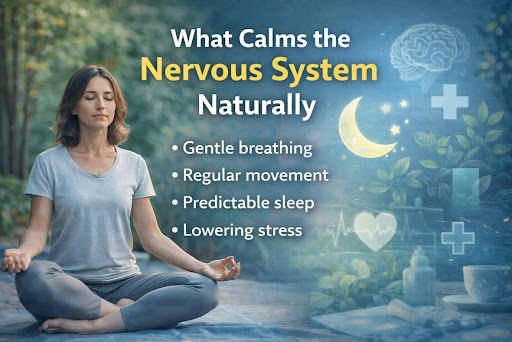
- Slow your breathing.
- Move gently.
- Protect sleep timing.
- Minimize stimulation in the evening.
- Mayo schedule your body rhythms.
In case these actions do not move anything despite the regular attempts, specialized advice may help to find out what makes the system speak with high alertness.
These patterns are explained in our Nervous System Wellness Guides and they will equip individuals in making informed discussions with healthcare providers.
Peace does not come by coercion.
It will allow you to make the right conditions to allow it.
And the nervous system when made safe, once it knows how, knows how to do the rest.